
 “When we hear that the Gross National Product has grown, instead of cheering, we should ask exactly what has grown, for whom, at what cost, and at whose expense. Even better, we should work to develop indicators of national progress that reflect more accurately our real value and our real welfare.” —Donella Meadows, 1988
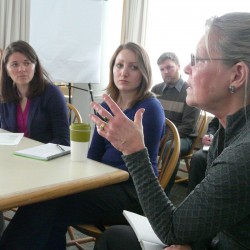
Elizabeth Courtney, author of Greening Vermont, takes [...]
“When we hear that the Gross National Product has grown, instead of cheering, we should ask exactly what has grown, for whom, at what cost, and at whose expense. Even better, we should work to develop indicators of national progress that reflect more accurately our real value and our real welfare.” —Donella Meadows, 1988
Elizabeth Courtney, author of Greening Vermont, takes [...]
Posts Tagged ‘happiness’
A Genuine Talk on Progress and the GPI
Posted by Kindle Loomis, Published: March 11th, 2014


“When we hear that the Gross National Product has grown, instead of cheering, we should ask exactly what has grown, for whom, at what cost, and at whose expense. Even better, we should work to develop indicators of national progress that reflect more accurately our real value and our real welfare.” —Donella Meadows, 1988
Elizabeth Courtney, author of Greening Vermont, takes [...]
Let’s Take Back Christmas: Donella Meadows on the Holiday Season
Posted by Kindle Loomis, Published: December 14th, 2012
Donella Meadows enjoyed many of the same things during the holidays that so many of us look forward to–time with family and loved ones, good music and good company, giving and sharing, warmth and light. As she wrote to her friends in December 1996, “I’m looking forward to it, the slowdown, the quietness. I light white candles and play beautiful [...]
Manifesto for a Post-Growth Economy
Posted by Kindle Loomis, Published: September 21st, 2012
By James Gustave Speth
 What single change stands to give Americans more free time, healthier ecosystems, and more meaningful jobs?
Slowing down GDP growth can mean more time to do things we love. Image credit: Qfamily via Flickr
Editor’s introduction: Gus Speth has been a co-founder of the Natural Resources Defense Council, an advisor to presidents Jimmy Carter and Bill Clinton, the head of the United Nations’ [...]
What single change stands to give Americans more free time, healthier ecosystems, and more meaningful jobs?
Slowing down GDP growth can mean more time to do things we love. Image credit: Qfamily via Flickr
Editor’s introduction: Gus Speth has been a co-founder of the Natural Resources Defense Council, an advisor to presidents Jimmy Carter and Bill Clinton, the head of the United Nations’ [...]
Sustainability and Happiness: A Development Philosophy for Bhutan and the World
Posted by Kindle Loomis, Published: September 4th, 2012
By Jigmi Thinley
 Thirty years ago, the fourth king of Bhutan famously proclaimed that “Gross National Happiness is more important than Gross National Product,” setting the country on a development path that seeks to integrate sustainable and equitable socioeconomic development with environmental conservation, cultural promotion, and good governance.
This “happiness” has nothing to do with the common use of that word to denote an [...]
Thirty years ago, the fourth king of Bhutan famously proclaimed that “Gross National Happiness is more important than Gross National Product,” setting the country on a development path that seeks to integrate sustainable and equitable socioeconomic development with environmental conservation, cultural promotion, and good governance.
This “happiness” has nothing to do with the common use of that word to denote an [...]


